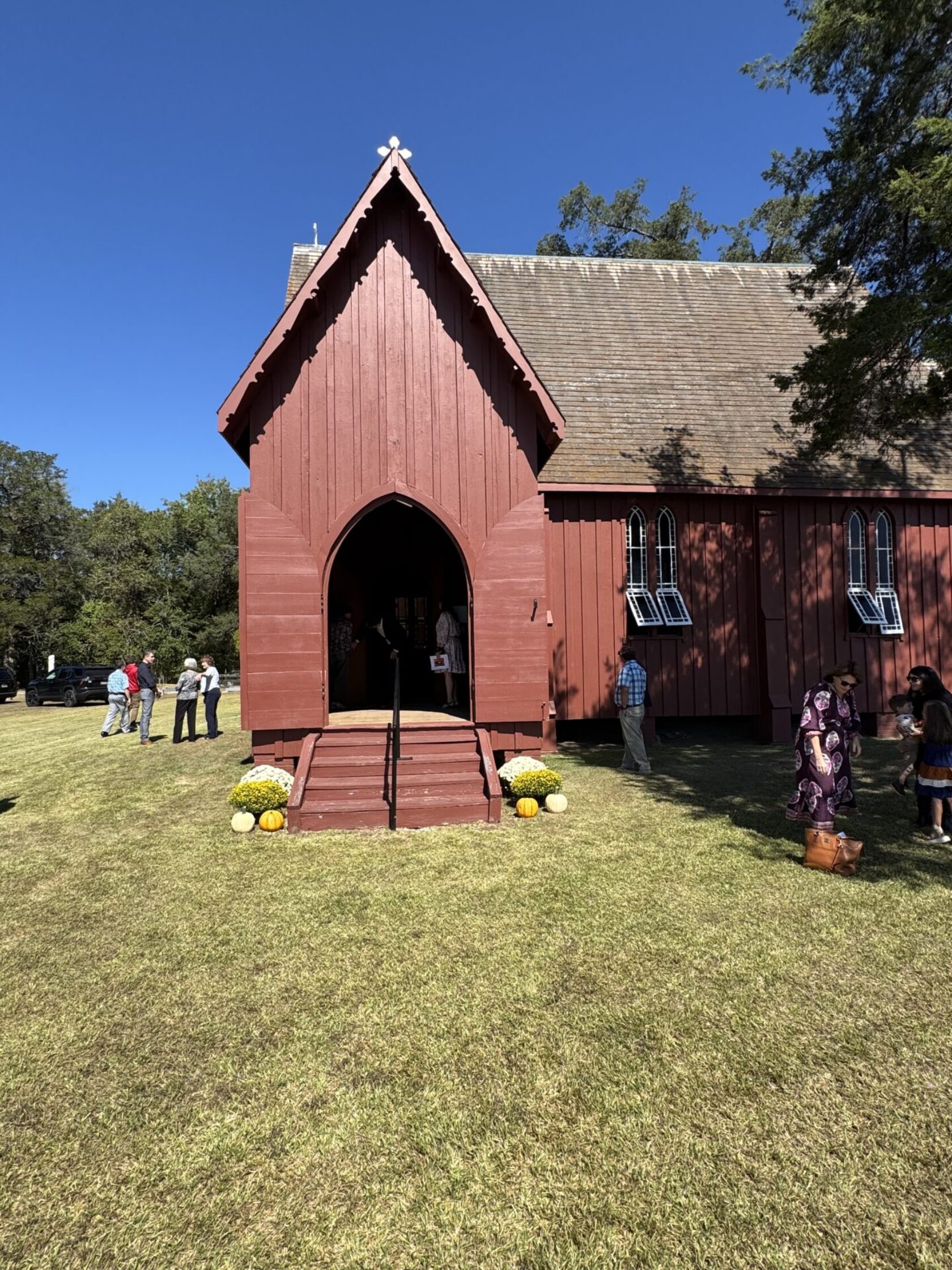
At a little red church in the Alabama Black Belt, Homecoming brings faith and memory together
The late Sunday morning sunlight spills through the stained-glass windows of St. Andrew’s Episcopal Church in Prairieville, AL, warming the nearly two-century-old handmade pews that are filled to capacity. Outside, open fields stretch toward the horizon as more worshippers listen to the service through loudspeakers. Inside, the faint scent of old wooden boards speaks of generations who have prayed in this small, steadfast place, now gathered once more for their beloved annual Homecoming service.
St. Andrew’s began humbly in the early mid-nineteenth century when the Rev. Caleb S. Ives traveled to Prairieville to lead Episcopal worship among the small but growing community of settlers who had come to the fertile Canebrake from the Atlantic states. Two decades later, under the leadership of the Rev. Francis R. Hanson, the congregation secured a three-acre plot for a church and graveyard and dreamed aloud of building what he described as “a neat and substantial church edifice.”
That dream came true in 1853 when plantation owner Henry A. Tayloe provided enslaved labor from his nearby plantation. Two freed master carpenters, Peter Lee and Joe Glascow, led the construction of a simple wooden Carpenter Gothic structure based on the designs of noted architect Richard Upjohn, becoming Alabama’s first-ever Gothic Revival Episcopal church. On April 18, 1858, Alabama’s first Episcopal bishop, Nicholas Hamner Cobbs, consecrated the completed church, one that would come to symbolize both the faith and endurance of the Black Belt’s early Episcopalians.
Before emancipation, St. Andrew’s served the planters of Perry, Hale, and Marengo counties, with records noting baptisms of both white families and enslaved persons. Local plantation owners would gather for worship in the morning, and enslaved people would worship in the afternoon. After the Civil War, the number of parishioners steadily decreased due to removals, deaths, and the general decline in the local population, leading to the end of St. Andrew’s regular worshiping congregation.
Officially listed on the National Register of Historic Places and designated a National Historic Landmark on November 7, 1973, St. Andrew’s Homecoming began around 1950, when the bishop of the Diocese of Alabama and the suffragan bishop, in alternate years, started holding a service on the fifth Sunday of a late-summer or early-fall month. These gatherings drew people from far and near, with worship followed by a picnic lunch under the shade of the trees in the churchyard. True to tradition, the old church was full to overflowing, as more than 130 people gathered to celebrate this year’s Homecoming.
“Homecoming is about coming home—to fill this empty place and reconnect with the people we miss,” said Bishop Glenda Curry as she began her homily at this year’s Homecoming service on Sunday, October 12. “You have helped keep the old parishes of the Black Belt connected and continue to share God’s Word with your community, and I am thankful for that.”
“Practice gratitude,” Curry continued. “It is a gift, a soul medicine, the memory of the heart. This is my message for today. There is a transformational power in giving thanks. What are you grateful for that you have today that you didn’t have last year? This is a chance to remember all the many blessings. Be grateful.”
Parishioners returning to St. Andrew’s—affectionately known as “the little red church” for its red-brown exterior—often speak of this historic building as a living companion. “When you sit here, you can feel all the prayers that have soaked into the wood,” said a group from St. Paul’s Episcopal Church in Greensboro, AL, whose family has attended services here for generations. “We come here every year. It’s a tradition.”
This continuity is what makes Homecoming Sunday so special. Descendants travel from miles around, filling the pews and spilling onto the lawn, gathering to remember and give thanks. This year, Bishop Curry joined parishioners from more than six Episcopal congregations, confirmed three new members, and celebrated the ongoing life of the church.
Since 1916, the rector of Trinity Episcopal Church in Demopolis has served as St. Andrew’s unofficial vicar. The Rev. Evan Thayer, the current vicar, is passionate about preserving St. Andrew’s for future generations. He describes its story in part as one of “people, the people who came out here to build lives and fortunes, through the toil of enslaved labor. It’s the story of craftsmen, who, though enslaved, found expression in the creation of a beautiful place of worship.” With help from the Diocese’s website initiative for small parishes, Thayer recently launched a new website that gathers the rich history and stories of St. Andrew’s in one place.
At St. Andrew’s, preservation goes beyond digital archives; it lives in the careful hands that mend, paint, and restore. Over the years, the church’s upkeep has long been supported by a trust fund established on November 1, 1886, by Mourning S. (Mrs. W. P.) Bocock. As a result, the little red church has undergone extensive restoration, funded by grants from the Diocese of Alabama, the Alabama Historical Commission, and generous individual donors. In 2022, the parish received a $26,636 grant from the Historical Commission for significant repairs, including the replacement of rotten wood, priming and repainting of the exterior, and the restoration of stained-glass windows above the altar and several historic monuments in the cemetery. In 2023, St. Andrew’s received a $5,000 Renew and Refresh Grant from the diocese to continue the stained-glass restoration, along with an additional $4,000 grant to support a new educational program preserving the church’s history for future generations.
For most of the year, St. Andrew’s—located on County Road 12 in Gallion—stands in quiet witness, its pews empty, its doors closed against the shifting Alabama weather. But once each year, the stillness breaks. Voices rise again within the old pine walls, and the prayers of a century and a half are renewed in chorus.
Except for the removal of the tower and the addition of a chimney on the nave’s south side, St. Andrew’s stands much as it did when built. Through war, hardship, and dwindling populations, St. Andrew’s has remained—as a true beacon of faith, fellowship, and the goodness of the Lord.
The writer is the Director of Communications. She can be reached at nana@dioala.org